7 Best Servo Drives for Industrial Automation in 2026?

Time:2026-11-12 Author:Charlotte
0%

Choosing a Servo Drive in 2026 means matching control performance to the real machine, not simply picking the highest-rated model. A packaging line may need rapid indexing and precise stopping. A CNC axis may demand smooth motion, stable feedback, and reliable operation under changing loads. Small details matter: encoder compatibility, bus support, commissioning tools, and the cabinet’s available space.

Motion-control engineer Peter Nachtwey has written extensively about feedback and control systems. A useful paraphrase of that engineering perspective is: judge motion by how the complete system performs, not by one component’s headline specification. This is a paraphrase, not a verbatim quotation. It points to a common selection mistake. A drive and motor can look impressive on paper, yet perform poorly when sizing, tuning, wiring, or load inertia is overlooked.

This guide compares seven widely used Servo Drive options for industrial automation in 2026. It considers practical factors such as power range, feedback support, network integration, setup effort, and application fit. No single model suits every machine. Some specifications also depend on the exact variant and firmware, so verify them with the manufacturer before purchase. The shortlist is a starting point, not a substitute for engineering review. One thing is easy to miss: the best drive is often the one your team can configure, troubleshoot, and support confidently.
7 Best Servo Drives for Industrial Automation in 2026?

How Servo Drives Enable Precise Motion in Industrial Automation

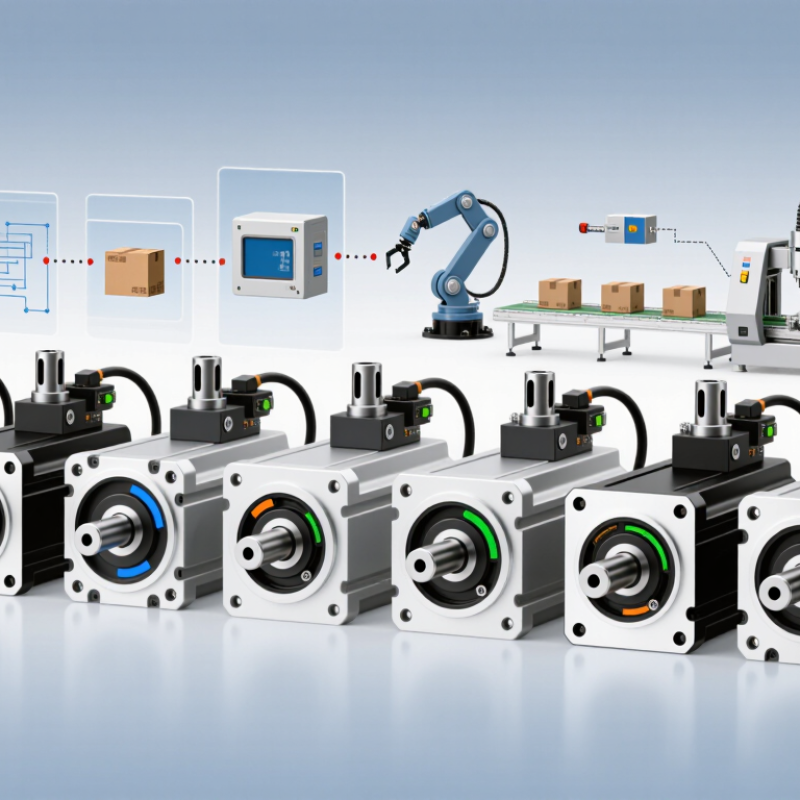
A servo drive controls a motor’s speed, torque, and position by adjusting electrical power in response to motion commands. In a packaging line, this can mean stopping a conveyor at a sensor mark rather than relying on a fixed timer. The drive reads feedback from an encoder and corrects the motor’s movement many times per second. If a load changes or the motor begins to lag, the control loop can respond. Small errors accumulate.

That precision depends on more than the drive itself. Engineers must match the motor, load, and drive capacity, then tune the system under real operating conditions. A vertical axis carrying a heavy tool, for example, may need different settings from a lightly loaded belt. Poor tuning can cause vibration, overshoot, or unwanted heat.

It is not always obvious which setting is responsible. Monitoring position error and current during commissioning helps reveal problems, but measurements should be checked against the machine’s actual behavior.

Servo control can improve repeatability and coordination between axes, yet it cannot compensate for loose couplings, worn bearings, or inaccurate mechanical alignment. That part is easy to underestimate.

What to Consider When Choosing a Servo Drive in 2026

Choosing a servo drive in 2026 starts with the machine, not the catalogue. Record the motor’s rated voltage, continuous current, and peak torque. Then check whether the drive can handle short acceleration bursts without tripping. A conveyor carrying uneven loads needs different tuning and overload capacity from a small pick-and-place axis. No single number wins.

Match the drive to the motor’s feedback device and the controller’s communication protocol. A mismatch can turn setup into hours of avoidable troubleshooting. Check regenerative handling, too: a fast-moving vertical axis may return energy during deceleration. The drive needs a suitable way to manage it. Consider the cabinet’s heat, dust, and available space, along with safety functions required by the machine design. During commissioning, stable motion at low speed can reveal problems that a quick top-speed test misses. Test both. Ask how tuning, fault codes, and replacement work in practice; a technically capable unit can still be a poor fit if support is hard to reach. I would be cautious about choosing extra capacity just to feel safe. It may add cost without fixing a weak mechanical design. Some details only become clear on the machine, so leave time for a careful trial.

7 Servo Drive Selection Factors for Industrial Automation in 2026

A practical comparison framework for evaluating servo drives—not a ranking of specific products.

How to read this: Scores are illustrative planning priorities on a 1–5 scale, not measured product ratings or market-survey results. Prioritize factors according to the machine’s motion requirements, installation environment, and safety needs.

Seven Servo Drives Compared by Features and Applications

Seven servo-drive types suit different machine demands. Pulse-train drives offer straightforward control for basic indexing. Analog-input models fit legacy equipment, but wiring and noise can complicate commissioning. Networked drives coordinate packaging lines and synchronized axes. Compact integrated drives save cabinet space on small machines. Safety-rated drives support monitored stopping functions. High-voltage models serve demanding, high-speed equipment. Multi-axis drives reduce wiring in robots and pick-and-place systems.

The International Federation of Robotics’ World Robotics 2024 report recorded 541,302 industrial robot installations in 2023. That scale makes synchronization, diagnostics, and service access practical selection criteria, not optional extras. The IEA’s 2011 energy-efficiency report estimated that motor systems use about 45% of global electricity; it does not isolate servo drives, but it underscores the value of correctly sized motors and drives. Regenerative capability may help on frequent deceleration cycles, though savings depend on the machine’s duty cycle.

Compare continuous torque, peak torque, feedback compatibility, network support, and cooling needs before choosing. A drive that looks powerful on paper may overheat inside a crowded cabinet. That gets missed. Application labels also hide trade-offs: a multi-axis unit saves space, yet a single fault can affect several axes. Review the actual motion profile and maintenance skills available. The best fit is sometimes less sophisticated.

How to Match a Servo Drive to an Industrial Machine

A servo drive should be selected around the machine’s actual motion, not just its motor rating. Start by listing the load, travel distance, cycle time, and stopping accuracy. Then estimate continuous torque and peak torque during acceleration. A motor that runs comfortably at steady speed may still overload during frequent starts. Don’t size from one number alone.

Consider the load’s inertia, too. A heavy rotary table or long belt can make a drive work harder when starting and stopping. Check the motor-to-load inertia ratio against the drive and motor specifications. Also confirm supply voltage, peak current, and whether the drive supports the machine’s control signals. A small mismatch can mean extra tuning—or a machine that never quite settles.

Feedback and operating conditions matter just as much. Choose compatible encoder feedback, and confirm the controller can communicate with the drive at the required update rate. For a dusty cabinet or warm production floor, check temperature limits, cooling clearance, and enclosure needs. Leave room for real-world variation. Calculations often miss friction changes or product weight.

Before committing, test representative motion profiles. Watch for overshoot, excessive current, and heat after repeated cycles. Record the results. A quick bench test is useful, but it may not reproduce the machine’s full load. That uncertainty deserves attention.

7 Best Servo Drives for Industrial Automation in 2026? - How to Match a Servo Drive to an Industrial Machine

Drive Type Typical Power and Supply Best-Fit Machines Motion and Feedback Considerations Key Matching Check
Compact single-axis servo drive Often about 50 W–750 W; supply class varies by design, commonly 200–240 V AC or a low-voltage DC bus. Small packaging equipment, benchtop automation, compact conveyors, and light pick-and-place axes. Typically controls one motor axis. Encoder feedback is common; available encoder types depend on the drive and motor. Confirm the motor’s rated current, peak current, bus voltage, and the machine’s acceleration needs.
General-purpose single-axis servo drive Often about 0.4–7.5 kW; 200–240 V AC and 380–480 V AC product classes are common. Packaging lines, feeders, indexing tables, machine tools, and general positioning axes. Usually supports position, velocity, and torque control; pulse-train and industrial-network interfaces vary by model. Match continuous and peak motor current, required speed, feedback device, and the controller’s command interface.
High-power single-axis servo drive Commonly several kilowatts to tens of kilowatts; typically uses a 380–480 V AC supply class. Large machine axes, heavy-duty converting equipment, presses, and high-inertia mechanisms. Requires careful motor and drive sizing for both continuous load and short-duration acceleration or overload demands. Check supply capacity, overload ratings, braking or regeneration needs, cable limits, and thermal conditions.
Multi-axis common-bus servo system Multiple axes share a power supply or DC bus; per-axis ratings range from small to high power depending on the system. Synchronized packaging machines, gantries, robotics, and coordinated production lines. Can reduce duplicated power components and support coordinated motion; axis count and bus architecture are system-specific. Assess simultaneous axis demand, shared-bus limits, regenerative energy, synchronization requirements, and expansion plans.
Regenerative servo drive Available across a range of power ratings; supply voltage class depends on the selected drive system. High-inertia or frequently decelerating axes, such as centrifuges, hoists, and rapid-cycle machinery. Returns suitable braking energy to the supply or shared DC bus rather than dissipating all of it in a braking resistor. Estimate deceleration energy and duty cycle; verify that the supply and installation support energy regeneration.
Direct-drive servo system Power and voltage vary widely with motor size; torque motors often operate at low speed and high torque. Rotary tables, indexing platforms, precision stages, and mechanisms where eliminating a gearbox is beneficial. Pairs with a direct-drive torque motor; precise feedback and suitable load-side inertia management are important. Compare required continuous and peak torque, speed, positioning accuracy, and the motor’s thermal limits.
Networked drive with integrated safety functions Available in multiple power and supply classes; safety features and network options depend on the drive. Machine cells requiring coordinated control, diagnostics, and safety functions such as Safe Torque Off. May communicate over an industrial network and provide certified safety functions; certification and supported functions must be verified. Match the control network and safety architecture, and confirm the required safety functions and ratings in the documentation.

Selection note: Power ranges and supply classes are indicative, not universal product specifications. Before selecting a drive, verify compatibility with the motor, feedback device, controller, load profile, ambient conditions, and applicable machine-safety requirements.

Integration and Maintenance Factors for Long-Term Reliability

Servo-drive reliability is often decided during integration, not at the moment of purchase. In 2026, compare supported communication protocols, encoder compatibility, and diagnostic access alongside rated torque. The U.S. Department of Energy’s 2014 industrial motor systems assessment reports that motor-driven systems account for about 68% of U.S. manufacturing electricity use. That figure is not servo-specific, but it shows why efficient commissioning and stable operation matter. Check cabinet cooling, grounding, and cable shielding on site; a noisy encoder signal can cause nuisance faults that look like drive failures.

Maintenance access matters, too. McKinsey’s 2018 analysis of predictive maintenance estimates potential reductions of 10–40% in maintenance costs and 30–50% in machine downtime. These are broad industry estimates, not guaranteed results for any servo installation. Use drive logs to track alarms, temperature, and following error, then compare trends with production conditions. Keep parameter backups and wiring diagrams where technicians can reach them. Small detail. Verify that replacement units can accept the saved configuration before a breakdown occurs. One caveat: more diagnostic data does not help if nobody reviews it regularly.

FAQS

What does a servo drive control?

It adjusts a motor’s speed, torque, and position to follow motion commands. An encoder reports movement, and the drive corrects errors many times per second.

How does feedback help a conveyor stop accurately?

An encoder can report the conveyor’s position near a sensor mark. The drive adjusts the motor instead of relying only on a fixed timer.

Why does servo tuning matter?

Settings should match the motor, load, and operating conditions. A heavy vertical tool may need different tuning from a lightly loaded belt. Poor settings can cause vibration, overshoot, or heat.

Can a servo drive fix mechanical problems?

No. It cannot correct loose couplings, worn bearings, or poor alignment. Small errors add up.

What should engineers check during integration?

Check communication protocols, encoder compatibility, and access to diagnostic information. On site, inspect cabinet cooling, grounding, and cable shielding. Noisy encoder signals can trigger misleading faults.

What data can help with maintenance?

Review alarms, temperature, and following error in drive logs. Compare changes with production conditions. A clean graph can still mislead.

Why keep configuration backups and wiring diagrams?

Technicians can use them during troubleshooting or replacement. Store them somewhere accessible, and confirm replacement units can use the saved configuration.

Does more diagnostic data guarantee fewer breakdowns?

No. Data helps only when someone reviews it regularly and responds to meaningful trends. That part is easy to overlook.

Conclusion

This guide explores how a Servo Drive supports precise, responsive motion in industrial automation by controlling motor speed, position, and torque. It outlines key factors to consider when selecting a drive in 2026, including machine requirements, performance, compatibility, operating conditions, and ease of integration. The article also compares seven types of servo drives by their features and typical applications, helping readers understand how different options may suit tasks such as positioning, synchronized movement, or continuous operation.

Choosing the right drive involves matching its capabilities to the machine’s motion profile, workload, and control system rather than relying on a single specification. The guide also highlights integration and maintenance practices that can support long-term reliability, such as verifying connections, configuring control parameters carefully, and planning routine inspections. Together, these considerations provide a practical framework for selecting and maintaining servo drive systems in industrial environments.


Charlotte

Charlotte

Charlotte is a seasoned marketing professional with a deep understanding of the company's portfolio and a passion for elevating its presence in the market. With a keen eye for detail and a commitment to excellence, she ensures that our professional blog is regularly updated with insightful articles......