An engineering evaluation of human-machine interaction (HMI) devices, differential pulse generation, signal integrity maintenance, and global distribution network resilience.
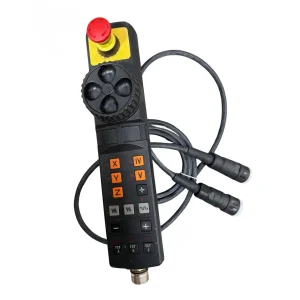
In high-precision Computer Numerical Control (CNC) machining operations, the manual pulse generator (MPG)—commonly referred to as an electronic handwheel—serves as the primary tactile interface between the machinist and the CNC control system. HEIDENHAIN electronic handwheels represent the industry standard for micro-positioning, workpiece alignment, and manual axis interception on advanced milling, turning, and multi-axis machining platforms such as the TNC 640, TNC 620, and MANUALplus 620.
Maintaining operational integrity across these devices is paramount. A single faulty step encoder knob, degraded membrane switch, or broken differential signal line can immediately halt multi-million-dollar production lines in aerospace, automotive die-making, and high-precision semiconductor tooling facilities. This paper outlines the structural principles, diagnostic protocols, and supply-chain considerations required to maintain uninterrupted operations.
Heidenhain handwheels utilize photoelectric scanning of glass grid disks to generate phase-shifted TTL or 1 Vpp sinusoidal signals. This contact-free scanning guarantees zero mechanical wear over millions of manual indexing detents.
Modern units like the HR 550FS and HR 520 feature integrated Dual-Circuit Emergency Stop loops and permissive switches complying with EN ISO 13849-1 (PL d/e) and SIL 2/3 requirements for safe machine access during setup.
Featuring oil-resistant polyurethane spiral cables, magnetic retention brackets, IP65-sealed rotary switches, and mechanical detent feelers calibrated for tactile feedback even when operators wear heavy industrial protective gloves.
Detailed comparative metrics for purchasing departments and maintenance engineering teams selecting replacement handheld units.
| Series Model | Interface Type | Axis Selection | Display / Keys | Safety Level | Primary Industrial Target |
|---|---|---|---|---|---|
| HR 410 / HR 410FS | Wired (Sub-D 15p / Flange) | Up to 5 Axes (Rotary Switch) | Keys forfeed rate & jogging | Optional FS (PL d) | Standard CNC Milling & Lathes |
| HR 510 / HR 510FS | Wired Direct Control Interface | 6 Axes (Keys + LEDs) | Status LEDs & Functional Keys | PL e / SIL 3 Compliant | 5-Axis Machining Centers |
| HR 520 / HR 520FS | Wired Extended Handwheel | Virtual & Physical Axes | Integrated FSI Display + Potentiometer | Dual Permissive Switch | Precision Die & Mold Tooling |
| HR 550FS Wireless | 2.4 GHz Transceiver Unit | Unlimited (Software Select) | Graphic LCD Display + Touch Keys | FS Wireless Stop (PL e) | Large Gantry & Aerospace Mills |
| HR 130 Panel-Mount | Direct Cabinet Bus Connection | 1 Axis per Encoder Unit | Bare Ergonomic Dial | Integrated Control Loop | Machine Operator Console Integration |
When requesting replacement units for older machine tools equipped with TNC 426 or TNC 430 controls, verify whether your installation requires a 11-pin sinusoidal (1 Vpp) signal or a 5V TTL square wave interface. Mismatched encoder electronics will result in CNC Alarm "Handwheel Signal Amplitude Defective". Contact our engineering desk with your handwheel ID number (e.g., ID 312806-01 or ID 536440-02) for 100% exact cross-referencing.
How high-precision tactile feedback accelerates setup times and prevents collision costs in critical manufacturing sectors.
In large automotive stamping tool shops, operators must manually jog the spindle down to fractions of a micron during tool proving. Using the HR 520 handwheel with fine incremental resolution (0.0001 mm steps), machinists visually inspect contact surfaces without risking tool chatter or cutter chipping against hardened tool steels (58-62 HRC).
Aerospace structural parts (titanium spars, aluminum monolithic ribs) require manual positioning inside massive multi-axis gantries. The HR 550FS Wireless Handwheel removes dangerous trailing cables across 15-meter bed lengths, granting engineers complete freedom of movement around the workpiece while holding an active wireless safety permissive switch.
In ultra-precision glass grinding and silicon substrate chuck positioning, electro-magnetic noise isolation is essential. Heidenhain handwheels utilize double-shielded twisted pair lines that suppress high-frequency interference generated by linear motor drives and high-speed motor spindles running above 40,000 RPM.
Machining massive steam turbine housings or wind turbine hub castings requires dual-operator cooperation. Remote handwheels equipped with LCD displays allow setting datum points directly at the bore face, transmitting axis coordinates back to the main console in real-time without requiring constant travel back to the CNC control panel.
Step-by-step technical procedures developed by field service engineers to diagnose electrical, optical, and mechanical failures.
Root Cause: Debris accumulation inside optical disk slots, degraded LED emitter current, or damaged spiral cord internal wires due to excessive stretching.
Diagnostic Procedure: Connect an oscilloscope to Channel A (0°) and Channel B (90°) differential output pins on the handwheel terminal connector. Rotate the dial at approximately 1 revolution per second. Verify that the voltage amplitude remains stable at 1.0 Vpp ± 0.2V (for sinusoidal units) or 5.0V TTL ± 0.25V (for square wave units). If amplitude drops below 0.6V, replace the internal optical encoder assembly or clean the scanning glass using isopropyl alcohol in a dust-free environment.
Root Cause: Broken wire in the dual-channel Emergency Stop safety circuit (Pins 11 and 12) or worn contacts inside the emergency push-button housing.
Diagnostic Procedure: Disconnect the handwheel plug from the CNC cabinet interface board. Measure resistance across the E-stop contacts using a calibrated digital multimeter. Unactuated state resistance must read less than 0.5 Ohms. Pressed state resistance must be infinite (>10 Megohms). If resistance fluctuates during handwheel cable movement, perform a wire continuity test along the spiral cord to locate internal conductor fatigue.
Root Cause: Coolant ingress past membrane keypads, oxidation on PCB conductive rubber pads, or PLC I/O bus communication failure.
Diagnostic Procedure: Access the CNC controller diagnostics screen (TNC Diagnostic Monitor). Monitor the input bit status corresponding to Axis Selection (X, Y, Z, IV, V). If bit status does not toggle from 0 to 1 when turning the rotary switch, disassemble the housing, inspect the contact wiper for mechanical bending, and clean with electronic contact cleaner.
Emerging trends in CNC human-machine interfaces, digital twin synchronization, and smart factory integration.
Next-generation handwheels are transitioning from legacy analog 1 Vpp interfaces toward the unified EnDat 3 serial interface. This reduces line counts from 12 conductors down to 2 or 4 wires while delivering real-time diagnostic telemetry, temperature sensing, and component hardware health metrics directly to the control CPU.
Future handwheels will incorporate active electro-magnetic detents capable of dynamically altering mechanical resistance. When approaching virtual soft-limits or machine envelope boundaries configured in the digital twin, the handwheel will exert physical counter-torque, mechanically preventing manual collision mistakes.
Building upon the HR 550FS platform, future wireless handwheels will implement ultra-wideband (UWB) safety channels with dynamic frequency hopping. This prevents latency interference even in ultra-dense factory environments operating hundreds of automated guided vehicles (AGVs) and wireless sensors simultaneously.
How our localized procurement network, automated testing rigs, and Ningbo port infrastructure deliver rapid turnaround for international machinery builders.
Located in the heart of Zhejiang’s advanced machinery manufacturing cluster, our Ningbo facility benefits from direct proximity to Ningbo-Zhoushan Port—the world's largest port by cargo tonnage. This enables rapid air-freight consolidation via Ningbo Lishe (NGB) and Shanghai Pudong (PVG) international hubs, securing 48-to-72-hour door-to-door express delivery across North America, Europe, and Southeast Asia.
Every Heidenhain handwheel serviced, refurbished, or shipped from our stock undergoes 100% full-function validation on specialized testing rigs equipped with original Heidenhain TNC controllers. We test pulse count uniformity, line driver signal symmetric jitter, permissive switch contact bounce, and IP65 pressure sealing before issuing an official inspection certificate.
Beyond Heidenhain components, our inventory holds over 5,000 SKUs covering Fanuc, Mitsubishi, Siemens, Renishaw, Fagor, Delta, and NSK products. This unified supplier model enables industrial plant managers to source complete CNC retrofit bundles—including handwheels, servo drives, encoders, and spindle bearings—on a single commercial invoice.
Ensuring seamless international machinery integration through adherence to global electromagnetic and functional safety standards.
All supplied handwheel units conform to European EMC Directive 2014/30/EU, meeting EN 61000-6-2 (Industrial Immunity) and EN 61000-6-4 (Industrial Emissions) standards to prevent RF noise interference with nearby automation equipment.
Handwheel models designated with the "FS" suffix feature redundant dual-circuit permissive switches and double-break Emergency Stop buttons independently certified by TÜV NORD to achieve Performance Level e (PL e) per ISO 13849-1.
Components supplied are fully compliant with EU Directive 2015/863 (RoHS 3) restricting hazardous substances, ensuring zero lead, cadmium, or toxic plasticizers are present in handwheel housings or cable jacketing.
Clear technical responses compiled by our senior CNC engineers for common buyer and technical queries.