How to Choose the Right Angular Contact Bearing?

Time:2026-10-03 Author:Oliver
0%

Choosing the right Angular Contact Bearing is more than matching a bore diameter to a shaft. The bearing must suit the machine’s speed, load direction, accuracy, and operating environment. A small pump, high-speed spindle, and robotic joint require different decisions. The wrong choice may create heat, vibration, noise, or early fatigue.

Start by examining the actual load pattern. Angular contact bearings can support combined radial and axial loads, but their capacity depends on the contact angle and arrangement. A 15-degree bearing may favor high-speed rotation, while a 40-degree design usually handles greater axial force. Consider single-row, paired, or double-row configurations. Duplex bearings also need a suitable arrangement, such as back-to-back or face-to-face. Small details matter. A few microns of misalignment can change running behavior.

Check the manufacturer’s dynamic load rating, static load rating, limiting speed, internal clearance, and preload guidance. Do not rely on price or appearance alone. A sealed bearing may reduce maintenance, while an open bearing can support relubrication in controlled equipment. Review lubricant compatibility, shaft and housing fits, temperature limits, and mounting procedures. Practical records often reveal more than a catalog. Inspect failed bearings for flaking, discoloration, brinelling, or uneven contact. These marks can expose incorrect preload or poor installation. No selection method is perfect. Real machines behave differently from calculations. Validate the choice through vibration readings, temperature checks, and service history before standardizing the design.
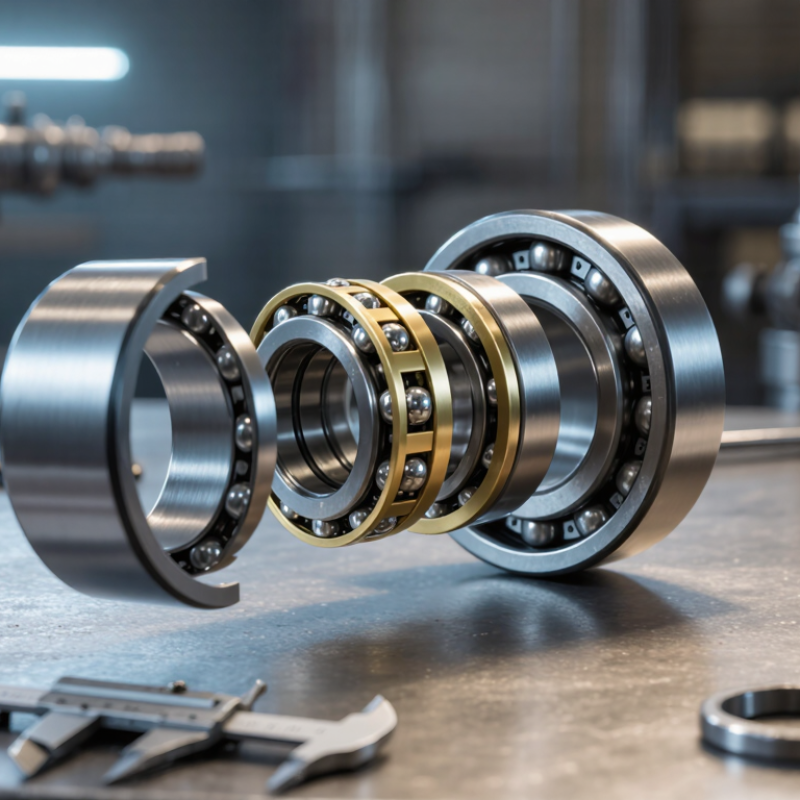
How to Choose the Right Angular Contact Bearing?

Understanding Angular Contact Bearing Design and Operating Principles

How to Choose the Right Angular Contact Bearing?

Angular contact bearing design centers on the contact angle. This angle controls how the bearing carries combined radial and axial loads. A larger angle improves axial-load capacity, but it usually reduces high-speed performance. A smaller angle supports faster rotation and lighter thrust loads. The rolling elements contact the raceways at a defined angle, creating an axial force path through the bearing.

Preload is equally important. Light preload can reduce vibration and improve running accuracy. Excessive preload creates heat, raises friction, and may shorten service life. ISO 281:2007 defines L10 life as the rating life reached by 90% of identical bearings under stated conditions. It is a calculation, not a promise. Real contamination, misalignment, and lubrication can change the result. That distinction is often overlooked.

Single-row bearings mainly handle axial load in one direction. Paired bearings support thrust in both directions and improve shaft stiffness. Back-to-back arrangements resist tilting moments effectively. Face-to-face arrangements tolerate small alignment errors better. Tandem pairs increase capacity in one axial direction.

Check speed limits, operating temperature, clearance, and lubricant viscosity together. ISO 15243 links premature damage to causes such as inadequate lubrication, contamination, and mounting errors.

In practice, a clean shaft shoulder matters. So does controlled nut torque. Selection can still be imperfect when actual loads fluctuate, because catalog calculations rarely capture every shock, thermal change, or installation mistake.

Identifying Load, Speed, and Precision Requirements

How to Choose the Right Angular Contact Bearing?

Choosing an angular contact bearing starts with the load, not the catalog number. Measure radial and axial forces separately, then identify their direction and frequency. A pump shaft may face continuous radial load and sudden axial thrust during startup. That detail can change the required contact angle.

Higher contact angles generally support greater axial loads. Lower angles usually suit higher rotational speeds. Check the bearing’s speed rating against the actual operating speed, including brief overspeed conditions. Heat matters too. Excessive preload can increase stiffness, but it may also raise friction and temperature. I have seen designs fail because preload was selected for precision alone.

Precision requirements should match the machine’s real behavior. Tight runout is valuable for machine tools, inspection equipment, and high-speed spindles. It may be unnecessary for a slower conveyor shaft. Consider shaft fit, housing rigidity, lubrication, and installation cleanliness. A highly precise bearing cannot correct a distorted housing.

For paired bearings, choose the arrangement carefully. Back-to-back layouts often resist moment loads effectively. Face-to-face layouts can tolerate slight alignment changes. Tandem arrangements improve axial capacity in one direction. Confirm stiffness, clearance, and thermal growth through calculation. Do not rely only on a static load rating. It describes one condition, not the entire service life.

A practical selection should balance load, speed, precision, temperature, and maintenance access. Some uncertainty will remain. Test the assembly under realistic heat and vibration before final production.

How to Choose the Right Angular Contact Bearing? - Identifying Load, Speed, and Precision Requirements

Application Requirement Typical Operating Condition Recommended Bearing Configuration Key Selection Guideline Reason
Predominantly radial load Radial force is much greater than axial force Single-row angular contact bearing with a smaller contact angle, commonly 15° or 25° Verify radial load rating and shaft rigidity Smaller contact angles generally favor radial load capacity and high-speed operation
Combined radial and axial load Axial load acts mainly in one direction Single-row angular contact bearing, often arranged in pairs when bidirectional support is needed Select the contact angle according to the axial-to-radial load ratio Angular contact geometry supports both radial and axial loads
High axial load Axial force is significant or thrust direction is dominant Bearing with a larger contact angle, commonly 25° or 40°; use matched pairs if required Check static load rating and axial load capacity A larger contact angle increases the bearing's ability to carry axial load
Bidirectional axial load Axial forces alternate or act in both directions Duplex arrangement such as back-to-back, face-to-face, or tandem Use back-to-back for moment stiffness; use face-to-face for misalignment tolerance A paired arrangement provides axial location in both directions
Very high axial load in one direction High thrust with limited space for multiple bearing sets Double-row angular contact bearing or tandem arrangement Confirm axial capacity, preload, and thermal behavior Two load paths increase axial support compared with a single row
High rotational speed Continuous operation near the machine's maximum shaft speed Light-section bearing, smaller contact angle, optimized cage, and suitable lubrication Compare reference speed and limiting speed; account for preload and heat generation Lower friction and controlled internal clearance reduce temperature rise
Low to moderate speed with heavy load High load and frequent shock or acceleration, but limited speed demand Larger load-capacity bearing with an appropriate contact angle and robust internal design Calculate dynamic and static safety factors, including shock loads A larger bearing section and suitable preload improve load carrying ability
General industrial precision Standard machinery with moderate speed, load, and positioning requirements Normal precision class with light or standard preload Select the basic precision class that satisfies runout and life requirements Avoiding unnecessary precision can reduce cost and friction
High positioning precision Low runout and repeatable shaft positioning are required Higher precision class with controlled preload and accurate mounting fits Check radial and axial runout, stiffness, thermal expansion, and installation accuracy Bearing precision alone cannot compensate for poor housing or shaft accuracy
Maximum stiffness Deflection under load must be minimized Preloaded duplex set, commonly back-to-back, with medium or heavy preload where heat allows Balance stiffness against friction, temperature rise, and service life Preload removes internal clearance and increases system rigidity
High-speed precision spindle High speed, low vibration, low runout, and controlled temperature Precision angular contact set with light preload and appropriate grease or oil-air lubrication Evaluate speed factor, preload force, lubricant, cooling, and dynamic balance The combination of precision, controlled preload, and lubrication limits heat and vibration
Temperature variation Wide operating temperature range or substantial thermal growth Low preload or spring-preloaded arrangement, with suitable internal clearance and materials Calculate thermal expansion of the shaft, housing, and bearing assembly Thermal growth can increase preload and cause excessive friction or premature failure
Contaminated or humid environment Dust, moisture, coolant, or corrosive exposure is possible Sealed bearing arrangement or protected housing with compatible grease and corrosion protection Confirm seal speed capability, lubricant compatibility, and maintenance interval Effective sealing helps prevent contamination-related raceway and lubricant damage
Long service life Continuous duty with limited maintenance access Bearing sized from the equivalent dynamic load, required life, lubrication, and contamination conditions Use the basic rating life equation and apply appropriate reliability and operating corrections Bearing life depends on load, speed, lubrication, cleanliness, alignment, and installation quality
Selection note: Confirm the bearing's dynamic load rating, static load rating, limiting speed, preload, precision class, lubrication method, mounting arrangement, and operating temperature before final selection.

Selecting the Proper Contact Angle and Bearing Configuration

How to Choose the Right Angular Contact Bearing?

Selecting the Proper Contact Angle and Bearing Configuration

Choosing an angular contact bearing starts with the contact angle. A smaller angle usually favors high-speed rotation and radial stiffness. A larger angle supports greater axial loads. Common options include 15, 25, and 40 degrees. The correct choice depends on load direction, speed, and operating temperature.

For a spindle with moderate axial force, a 15-degree bearing may reduce friction and heat. A pump shaft facing stronger thrust may need a 25- or 40-degree design. However, contact angle alone cannot determine performance. Preload, lubrication, shaft deflection, and housing accuracy also matter. I have seen designs fail because engineers selected a suitable angle but ignored thermal expansion.

Bearing configuration changes how paired bearings manage force. Back-to-back arrangements provide strong moment rigidity and suit short, stiff shafts. Face-to-face arrangements tolerate slight alignment errors more effectively. Tandem pairs carry axial loads in one direction and often require another bearing arrangement for reverse thrust. Installation errors remain surprisingly common. Even a small spacer mismatch can create excessive preload, noise, and early fatigue. Check the manufacturer’s technical data, measure the mounting conditions, and validate the choice under actual duty cycles. A calculation may look correct on paper, yet field temperatures can expose weaknesses.

Matching Materials, Lubrication, and Sealing Options

Choosing the right angular contact bearing starts with the operating environment, not only the load rating. Chromesteel suits many clean, moderate-temperature applications. Stainless steel helps resist moisture, but it may offer lower fatigue strength. Ceramic rolling elements reduce mass and electrical damage risk in some high-speed systems, although they cost more and need careful installation. ISO 281 provides the basic rating-life method, but real service life also depends on contamination, preload, alignment, and temperature. A perfect specification rarely survives the factory floor.

Lubrication deserves deliberate attention. The U.S. Department of Energy’s maintenance guidance reports that improper lubrication contributes to more than half of bearing failures in many rotating systems. Use grease when relubrication access is limited, but check compatibility, base oil viscosity, and operating speed. Oil can remove heat more effectively in high-speed applications. Too much grease can raise temperature quickly. I have seen this mistake repeatedly. Seals should match the contamination risk: contact seals protect against dust and water, while non-contact shields usually create less friction. ISO 15243 failure analysis also links surface damage with contamination and inadequate lubrication.

Tips:

Select material after checking load, speed, moisture, and electrical conditions. Match lubricant viscosity to temperature and speed. Do not assume a tighter seal is always better. Verify preload and sealing torque during testing, then inspect grease condition after initial operation. Industry reliability surveys show that small installation errors often become expensive failures, so document every adjustment.

Evaluating Installation, Maintenance, and Service Life

How to Choose the Right Angular Contact Bearing?

Evaluating Installation, Maintenance, and Service Life

Installation determines much of an angular contact bearing’s future. Match the contact angle and arrangement to the axial load direction. Confirm the orientation before pressing the bearing into place. A reversed pair can run quietly but carry the wrong load. That mistake is easy to miss.

Use clean tools, measured fits, and even pressure across the correct ring. Never transfer force through the rolling elements. I have seen small installation marks become loud vibration after several operating hours. Check shaft and housing dimensions with calibrated instruments. Excessive interference may raise preload and operating temperature. Insufficient interference can allow damaging creep.

Maintenance should follow actual operating conditions, not only a calendar. Inspect temperature, noise, vibration, and lubricant condition during routine service. Grease quantity matters. Too much grease can create heat, especially at high speed. Too little grease accelerates wear. Keep seals and surrounding surfaces clean. Dust often enters during maintenance, not normal operation.

Service life depends on load, speed, alignment, lubrication, and heat. Record these conditions when selecting the bearing. A calculated life may look excellent, yet poor alignment can shorten it sharply. This is where selection becomes less certain. Field measurements may expose assumptions that design calculations missed. Replace a bearing when symptoms show progressive damage, rather than waiting for complete failure. Small changes deserve attention.

FAQS

How does contact angle affect bearing performance?

A 15-degree angle generally supports higher speed and radial stiffness. Larger angles handle stronger axial loads. Choose according to load direction, speed, and temperature.

Which contact angle suits a spindle with moderate axial force?

A 15-degree bearing may reduce friction and heat. This is not automatic. Check preload, lubrication, shaft deflection, and housing accuracy too.

When is a larger contact angle useful?

A 25- or 40-degree design may suit a pump shaft with stronger thrust. It can carry more axial force. However, greater axial capacity may affect speed and heat.

How should paired bearings be configured?

Back-to-back pairs provide strong moment rigidity for short, stiff shafts. Face-to-face pairs tolerate slight alignment errors more effectively. Tandem pairs carry axial loads in one direction.

What installation mistake can damage a bearing?

A reversed pair may run quietly while carrying the wrong load. That error is easy to miss. Confirm orientation before pressing the bearing into place.

How should an angular contact bearing be installed?

Use clean tools and measured fits. Apply even pressure through the correct ring. Never transfer force through the rolling elements. Small marks can later become loud vibration.

How much lubricant should be used?

Use a quantity suited to speed, temperature, and operating conditions. Too much grease can create heat during high-speed operation. Too little lubricant accelerates wear. The balance is easy to underestimate.

What should routine maintenance check?

Monitor temperature, noise, vibration, and lubricant condition. Keep seals and nearby surfaces clean. Dust often enters during maintenance. Do not rely only on a calendar.

What determines bearing service life?

Load, speed, alignment, lubrication, and heat all matter. A calculation may look excellent on paper. Field temperatures can reveal hidden weaknesses. I would recheck the assumptions.

When should a bearing be replaced?

Replace it when progressive damage symptoms appear. Watch for rising noise, vibration, temperature, or lubricant changes. Do not wait for complete failure. Small changes deserve attention.

Conclusion

Choosing the right Angular Contact Bearing begins with understanding how its internal geometry supports combined radial and axial loads. The contact angle, number of rows, and arrangement directly influence load capacity, stiffness, speed capability, and directional performance. Before making a selection, define the application’s operating conditions, including expected loads, rotation speed, accuracy requirements, temperature, and available installation space. These factors help determine the most suitable bearing configuration and contact angle for stable, efficient operation.

Material selection, lubrication, and sealing also play an important role in reliability and service life. The bearing should be matched with a lubricant that suits the operating speed, temperature, and maintenance schedule, while appropriate seals can help limit contamination and retain lubrication. Finally, correct installation practices, alignment, preload adjustment, inspection, and replacement planning should be considered together. A carefully selected and properly maintained Angular Contact Bearing can improve motion precision, reduce wear, and deliver dependable performance throughout its intended service life.


Oliver

Oliver

Oliver is a seasoned marketing professional with a wealth of expertise in driving brand awareness and engagement. With a deep understanding of our company's product offerings, he consistently delivers high-quality content that enriches our professional blog. His insights not only shed light on......